Table of Contents
Introduction: “Doctor, I’m Only 28. Am I Too Young for Botox?”
A question I hear increasingly often in my clinic is:
“Doctor, I’m only 28. Should I start Botox now?”
Or sometimes,
“I don’t really have wrinkles yet, but everyone keeps talking about preventive Botox.”
Others ask,
“Will starting Botox early make my skin dependent on it?”
These are excellent questions.
The growing popularity of preventive Botox has created both awareness and confusion.
Social media influencers often recommend getting Botox in your twenties.
Celebrities openly discuss it.
Friends compare treatments.
But what is actually true?
Should everyone start Botox before wrinkles appear?
Or is it simply another beauty trend?
At Derma Solutions in Marathahalli, Bengaluru, I believe patients deserve honest, evidence-based guidance—not fear-based marketing or unnecessary procedures.
The truth is this:
Preventive Botox can be beneficial for the right person at the right time—but it is not necessary for everyone.
Age alone should never determine treatment.
Instead, the decision depends on how your facial muscles move, your skin quality, your genetics, your lifestyle, and your long-term goals.
Before deciding whether preventive Botox is appropriate, let’s first understand what it actually is—and what it isn’t.
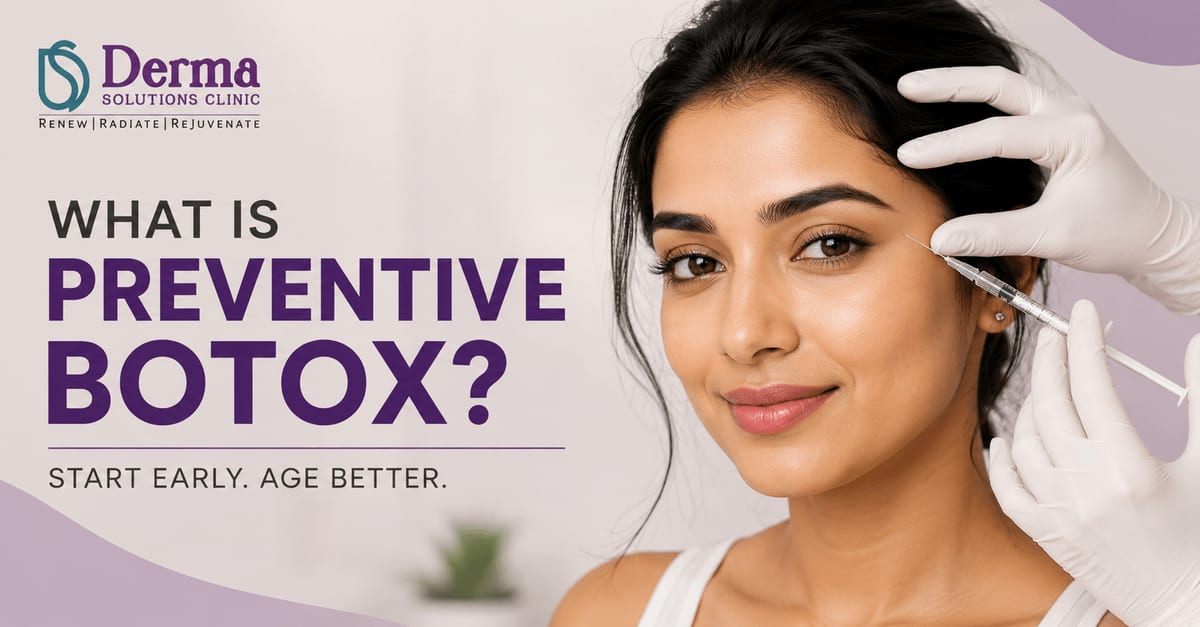
What Is Preventive Botox?
Most people think Botox is used only after wrinkles become deep.
That is only part of the story.
Preventive Botox aims to reduce repetitive muscle movements that gradually create permanent lines in the skin.
Every day, we smile.
Laugh.
Raise our eyebrows.
Squint.
Frown.
These facial expressions are completely natural.
However, after thousands of repetitions over many years, the skin begins to crease.
Initially, these lines appear only while making expressions.
These are called dynamic wrinkles.
Over time, repeated folding of the skin causes those lines to remain visible even when the face is completely relaxed.
These become static wrinkles.
Preventive Botox attempts to interrupt this process before permanent wrinkles become deeply established.
Instead of correcting advanced ageing, the goal is to delay its appearance.
Dynamic Wrinkles vs Static Wrinkles
Understanding this difference is essential.
Dynamic Wrinkles
These appear only during facial movement.
For example:
- Raising the eyebrows
- Smiling
- Frowning
- Squinting
When the face relaxes, these lines disappear.
This is the stage where preventive Botox may be considered.
Static Wrinkles
Static wrinkles remain visible even when the face is completely relaxed.
Examples include:
- Permanent forehead lines
- Deep frown lines
- Established crow’s feet
At this stage, Botox may soften the appearance but often cannot completely erase the wrinkle.
Additional treatments such as lasers, skin boosters, or collagen stimulation may also be recommended.
This is one reason why some patients choose early intervention.
How Does Botox Work?
Botox is a purified protein that temporarily relaxes selected facial muscles.
It does not fill wrinkles.
It does not stretch the skin.
It simply reduces excessive muscle activity.
When muscles contract less forcefully, the overlying skin folds less frequently.
This gives the skin more opportunity to remain smooth over time.
In preventive Botox, the goal is not to stop facial expressions.
The objective is simply to reduce repeated, excessive muscle movements that contribute to wrinkle formation.
A well-performed treatment should allow you to look natural, expressive, and refreshed.
Does Preventive Botox Actually Prevent Wrinkles?
This is one of the most searched questions online.
The answer is:
It may delay the development of certain expression lines in carefully selected patients.
Preventive Botox does not stop the ageing process.
Ageing is influenced by many factors, including:
- Genetics
- Sun exposure
- Smoking
- Skin type
- Collagen loss
- Hormonal changes
- Lifestyle
- Nutrition
Botox addresses only one component of ageing—repetitive muscle movement.
This is why I always explain to patients that Botox should never replace healthy skincare habits.
Daily sunscreen, moisturisers, retinoids (when appropriate), and a healthy lifestyle remain equally important.
Who May Benefit from Preventive Botox?
Not everyone needs Botox in their twenties.
Treatment should always be individualised.
Some people naturally have stronger facial muscles.
Others have highly expressive faces.
These individuals may begin developing dynamic lines earlier than others.
Patients who may benefit include those who:
- Notice forehead lines when raising their eyebrows
- Develop deep frown lines during concentration
- Squint frequently due to bright sunlight
- Have early crow’s feet while smiling
- Have a strong family history of early wrinkles
- Want a long-term preventive approach under dermatologist guidance
However, treatment should never be based solely on age.
A 25-year-old may not need Botox.
A 35-year-old may not need it either.
Similarly, someone in their late twenties with very active facial muscles may benefit from conservative treatment.
Every face is different.
What Is the Ideal Age to Start Preventive Botox?
There is no universal age.
This surprises many patients.
People often expect a simple answer like:
“Start at 25.”
Or,
“Start after 30.”
Unfortunately, skin ageing does not follow birthdays.
Some individuals develop visible dynamic wrinkles in their twenties.
Others maintain smooth skin into their forties.
Rather than asking:
“How old am I?”
Ask:
“Is my skin already showing early expression lines?”
That is a much more useful question.
For many patients, the late twenties to early thirties is when consultations begin—not because everyone needs Botox, but because early assessment allows us to recommend the most appropriate preventive strategy.
Areas Commonly Treated with Preventive Botox
Preventive Botox usually involves relatively small amounts of product.
The most commonly treated areas include:
Forehead Lines
Repeated eyebrow lifting gradually creates horizontal forehead lines.
Patients who naturally raise their eyebrows during conversation often notice these lines earlier.
Frown Lines
Also called glabellar lines.
These vertical lines develop between the eyebrows due to repeated frowning or concentrating.
Many patients say they appear tired, angry, or stressed even when relaxed.
Crow’s Feet
These fine lines around the eyes develop through smiling and squinting.
Early treatment may help soften repeated folding of the skin.
Preventive Botox Is Not About Looking Frozen
This is one of the biggest myths I hear.
Many people worry they will lose facial expressions.
That is not the goal.
Modern aesthetic dermatology focuses on natural movement.
The objective is simply to reduce excessive muscle activity—not eliminate expression.
Friends should notice that you look refreshed.
Not that you’ve had Botox.
Social Media Has Changed the Conversation
Platforms like Instagram, YouTube, and TikTok have made cosmetic treatments more visible than ever before.
Unfortunately, they have also created unrealistic expectations.
Some influencers recommend Botox as a routine treatment for everyone in their early twenties.
Others portray it as a miracle solution that completely prevents ageing.
Neither extreme is accurate.
A good dermatologist does not recommend Botox because it is trending.
Treatment should always be based on clinical assessment.
Not algorithms.
Not celebrity culture.
Not peer pressure.
Prevention Doesn’t Always Mean Botox
One of the most important conversations I have with younger patients is this:
Preventive Botox is only one part of preventive skin ageing.
Sometimes, Botox isn’t needed at all.
For many patients, prevention begins with:
- Daily sunscreen
- Medical-grade skincare
- Retinoids (when appropriate)
- Antioxidants like Vitamin C
- Adequate sleep
- Healthy nutrition
- Avoiding smoking
- Stress management
These habits often have a greater long-term impact than any injectable treatment.
Who Is a Good Candidate for Preventive Botox?
One of the biggest misconceptions is that everyone should start Botox once they reach a certain age.
That simply isn’t true.
Preventive Botox should always be personalised.
At Derma Solutions, I don’t recommend Botox based on birthdays.
I recommend it based on facial movement, skin quality, muscle activity, and long-term goals.
A good candidate may be someone who:
- Has visible dynamic wrinkles during facial expressions
- Notices forehead or frown lines becoming more prominent
- Has strong facial muscles that repeatedly crease the skin
- Has a family history of early wrinkle formation
- Wants subtle, preventive treatment rather than corrective procedures later
- Understands that Botox is part of a long-term skin health plan—not a one-time solution
The decision should always be made after a detailed consultation.
Who May Not Need Preventive Botox Yet?
Sometimes, patients visit me expecting Botox because they have seen it on social media.
After examining their skin, I often tell them they don’t need it.
Instead, we may focus on:
- Daily sunscreen
- Medical-grade skincare
- Retinoids (when appropriate)
- Hydrating moisturisers
- Antioxidant serums
- Lifestyle improvements
Good dermatology isn’t about performing more procedures.
It’s about recommending the right treatment at the right time.
Sometimes, the best treatment is no injectable at all.
Is Preventive Botox Safe?
This is one of the most frequently searched questions online.
When administered by a qualified dermatologist using approved products and appropriate techniques, Botox has an excellent safety profile.
Like any medical procedure, it should never be considered completely risk-free.
Possible temporary side effects include:
- Mild redness
- Small injection-site swelling
- Minor bruising
- Temporary headache
- Mild tenderness
These usually resolve within a few days.
Serious complications are uncommon when treatment is performed by an experienced medical professional who understands facial anatomy.
This is one reason why choosing a qualified dermatologist matters far more than chasing discounts or trends.
Will My Face Look Frozen?
Probably the biggest fear patients have is this:
“Doctor, I don’t want people to know I’ve had Botox.”
Neither do I.
Modern preventive Botox is designed to preserve natural expressions.
The goal is not to eliminate movement.
It is to reduce excessive muscle activity that contributes to wrinkle formation.
A good treatment should allow you to smile.
Laugh.
Express yourself.
Your friends may simply say,
“You look fresh.”
Not,
“What did you get done?”
Natural results are always the goal.
Does Preventive Botox Make You Dependent?
No.
This is another common myth.
Botox does not create physical dependence.
If you decide to stop treatment, your muscles gradually regain their normal activity over several months.
Your face does not become worse than before.
Instead, your skin simply continues its natural ageing process.
Patients sometimes think they have “aged suddenly” after stopping Botox.
In reality, they are simply noticing the gradual ageing that would have occurred anyway.
What Happens If You Stop Botox?
This is an important question.
Nothing harmful happens.
Gradually:
- Muscle activity returns
- Facial expressions become stronger again
- Dynamic wrinkles slowly reappear
- Natural ageing continues
Botox does not permanently change your face.
It also does not accelerate ageing if discontinued.
This reassurance is important for patients who want flexibility in their treatment decisions.
Preventive Botox Is Not a Replacement for Good Skincare
One of the biggest mistakes people make is believing Botox alone can prevent ageing.
It cannot.
Healthy skin requires a comprehensive approach.
Even patients receiving Botox should continue:
- Daily sunscreen (SPF 30 or higher)
- Gentle cleansing
- Regular moisturising
- Vitamin C serum, if recommended
- Retinoids under dermatologist guidance
- Healthy nutrition
- Adequate sleep
- Hydration
- Stress management
Think of Botox as one tool—not the entire toolbox.
Common Myths About Preventive Botox
Myth 1: Botox Is Only for Older People
False.
Preventive Botox is intended to address early dynamic wrinkles before they become deeply established.
However, not everyone in their twenties or thirties requires treatment.
Myth 2: Starting Early Means You’ll Need Botox Forever
False.
There is no obligation to continue treatment.
Many patients choose maintenance because they like the results, not because their skin has become dependent.
Myth 3: Botox Completely Stops Ageing
False.
Ageing continues regardless of treatment.
Botox only reduces wrinkle formation caused by repetitive muscle movement.
Sun exposure, genetics, collagen loss, lifestyle, and environmental factors still influence skin ageing.
Myth 4: Everyone Needs Preventive Botox
False.
Some individuals develop wrinkles later than others.
Others maintain excellent skin through consistent skincare and sun protection.
Treatment should never be based on trends.
Myth 5: More Botox Gives Better Results
False.
Over-treatment can create an unnatural appearance.
In aesthetic medicine, subtlety is often the key to achieving beautiful, long-lasting results.
Less is often more.
What Happens During a Preventive Botox Consultation at Derma Solutions?
Every consultation begins with understanding your concerns.
I ask patients questions such as:
What bothers you most?
When did you first notice these lines?
Do they appear only during expression or even at rest?
Have they changed over time?
I then perform a detailed facial assessment.
This includes evaluating:
- Muscle strength
- Facial symmetry
- Existing dynamic wrinkles
- Static wrinkles
- Skin quality
- Collagen loss
- Sun damage
- Facial anatomy
- Medical history
- Lifestyle factors
Only after this assessment do we discuss whether preventive Botox is appropriate.
Sometimes, I recommend Botox.
Sometimes, I suggest postponing treatment.
Sometimes, we focus entirely on skincare.
Every recommendation is personalised.
My Advice to Patients Considering Preventive Botox
Don’t start because someone on social media told you to.
Don’t delay because of myths.
Instead:
Learn about your skin.
Protect it from the sun.
Develop a consistent skincare routine.
Seek advice from a qualified dermatologist.
Choose prevention over correction whenever appropriate.
And remember—
Healthy ageing is not about looking younger than everyone else.
It’s about maintaining healthy, confident skin that reflects how you feel.
Frequently Asked Questions
1. What is preventive Botox?
Preventive Botox involves using small amounts of botulinum toxin to reduce repetitive facial muscle movements that contribute to wrinkle formation before deep lines become permanent.
2. At what age should I start preventive Botox?
There is no ideal age for everyone.
Treatment depends on your facial muscle activity, skin condition, genetics, and the presence of early dynamic wrinkles—not simply your age.
3. Is 25 too early for Botox?
Not necessarily.
Some people may benefit from an early consultation, while many individuals in their twenties require only good skincare and sunscreen.
4. Does preventive Botox actually work?
Research suggests that reducing repetitive muscle movement may delay the development of certain expression lines in appropriately selected patients.
5. Will I look unnatural after Botox?
Not when performed correctly.
Modern preventive Botox aims to preserve natural facial expressions while softening excessive muscle movement.
6. How long do preventive Botox results last?
Results typically last around three to four months, although this varies from person to person.
7. Does Botox hurt?
Most patients describe the injections as a brief pinching sensation.
The procedure is usually completed within a few minutes.
8. Can men get preventive Botox?
Absolutely.
Many men choose preventive Botox to reduce forehead lines, frown lines, and crow’s feet while maintaining a natural appearance.
9. Is preventive Botox safe for Indian skin?
Yes.
Since Botox works on muscles rather than skin colour, it is suitable for all skin types when performed by a qualified dermatologist.
10. Can Botox prevent all wrinkles?
No.
Botox primarily targets wrinkles caused by muscle movement.
Sun damage, collagen loss, skin laxity, and lifestyle factors also contribute to ageing.
11. Will my wrinkles become worse if I stop Botox?
No.
Your muscles gradually regain normal movement, and the natural ageing process continues.
Stopping Botox does not make wrinkles worse than they would have been otherwise.
12. Is preventive Botox better than waiting until wrinkles appear?
For selected patients with early dynamic wrinkles, preventive treatment may help delay deeper wrinkle formation.
The decision should always be individualised.
13. Can preventive Botox be combined with other treatments?
Yes.
Many patients benefit from combining Botox with medical-grade skincare, sunscreen, skin boosters, lasers, or collagen-stimulating procedures depending on their skin concerns.
14. How often should preventive Botox be repeated?
Most patients undergo maintenance treatments approximately every three to four months, although treatment intervals vary.
15. How do I know if preventive Botox is right for me?
The best way is through a consultation with an experienced dermatologist who can assess your facial anatomy, skin condition, muscle activity, and long-term goals.
Final Thoughts
Preventive Botox has changed the way we think about ageing.
Instead of waiting for wrinkles to become deeply established, dermatologists now have the opportunity to help selected patients protect their skin earlier.
But it is important to remember that Botox is not a necessity.
It is not a trend everyone must follow.
It is one option within a broader strategy of healthy skin ageing.
At Derma Solutions, my philosophy is straightforward.
Educate first.
Evaluate carefully.
Recommend only what is necessary.
Focus on natural, long-term results.
Because good aesthetic medicine is never about changing your face.
It is about helping you age with confidence.
References
- American Academy of Dermatology – https://www.aad.org/public/everyday-care/skin-care-secrets/anti-aging/reduce-premature-aging
- NCBI Bookshelf – Botulinum Toxin: https://www.ncbi.nlm.nih.gov/books/NBK557387/
- American Society for Dermatologic Surgery – https://www.asds.net/
- PubMed – Botulinum Toxin in Aesthetic Medicine: https://pubmed.ncbi.nlm.nih.gov/38148709/
- National Institute on Aging – https://www.nia.nih.gov/health/skin-care-and-aging